Showing posts with label TOBACCO. Show all posts

Wednesday, 10 August 2011

10 health benefits of stopping smoking

Many of us still didn't realise the benefits of not smoking.  Most of us still choose to be a smoker even though many Bad article about smoking has been produced. Why does it happen? Is it because they not afraid of being sick? For me, i think it is more meaningful if we motivate them rather than blame them. So today, i will share about the benefit of not smoking. Enjoy!! 

Smoking’s bad for your health, but exactly how does quitting make life better?

Better sex
Stopping smoking improves the body’s bloodflow, so improves sensitivity. Men who stop smoking may get better erections. Women may find that their orgasms improve and they become aroused more easily. It’s also been found that non-smokers are three times more appealing to the opposite sex than smokers (one of the advantages, perhaps, of smelling fresh).
Find out more tips for having good sex.

Improved fertility
Non-smokers find it easier to get pregnant. Quitting smoking improves the lining of the womb and can make men’s sperm more potent. Becoming a non-smoker increases the possibility of conceiving through IVF and reduces the likelihood of having a miscarriage. Most importantly, it improves the chances of giving birth to a healthy baby.

Younger looking skin
Stopping smoking has been found to slow facial ageing and delay the appearance of wrinkles. The skin of a non-smoker gets more nutrients, including oxygen, and can reverse the sallow, lined complexion that smokers often have.
Watch this video to find out how smoking can ruin your looks.

Whiter teeth
Giving up tobacco stops teeth becoming stained, and you'll have fresher breath. Ex-smokers are less likely than smokers to get gum disease and lose their teeth prematurely.
Find out more about dental health.

Better breathing
People breathe more easily and cough less when they give up smoking because their lung capacity improves by up to 10% within nine months. In your 20s and 30s, the effect of smoking on your lung capacity may not be noticeable until you go for a run, but lung capacity naturally diminishes with age. In later years, having maximum lung capacity can mean the difference between having an active, healthy old age and wheezing when going for a walk or climbing the stairs.

Longer life
Half of all long-term smokers die early from smoking-related diseases, including heart disease, lung cancer and chronic bronchitis. Men who quit smoking by 30 add 10 years to their life. People who kick the habit at 60 add three years to their life. In other words, it’s never too late to benefit from stopping. Quitting not only adds years to your life, but it also greatly improves the chance of a disease-free, mobile, happier old age.

Less stress
Scientific studies show that people's stress levels are lower after they stop smoking. Nicotine addiction makes smokers stressed from the ‘withdrawal’ between cigarettes. The pleasant feeling of satisfying that craving is only temporary and is not a real cure for stress. Also, the improved levels of oxygen in the body means that ex-smokers can concentrate better and have increased mental wellbeing.

Improved senses
Kicking the smoking habit gives your senses of smell and taste a boost. The body is recovering from being dulled by the hundreds of toxic chemicals found in cigarettes.

More energy
Within 2 to 12 weeks of stopping smoking, the circulation improves. This makes all physical activity, including walking and running, much easier. Quitting boosts the immune system, making it easier to fight off colds and flu. The increase in oxygen in the body makes ex-smokers less tired and less likely to have headaches.

Healthier loved ones
By stopping smoking you'll be protecting the health of your non-smoking friends and family.
Passive smoking increases a non-smoker's risk of lung cancer, heart disease and stroke. Second-hand smoke makes children twice at risk of chest illnesses, including pneumonia, croup (swollen airways in the lungs) and bronchitis, plus more ear infections, wheezing and asthma. They also have three times the risk of getting lung cancer in later life compared with children who live with non-smokers.
Quitting is good for their health as well as yours.

 The quitting timeline
  • After 20 minutes your blood pressure and pulse return to normal.
  • After 24 hours your lungs start to clear.
  • After two days your body is nicotine-free and your sense of taste and smell improve.
  • After three days you can breathe more easily, and your energy increases.
  • After two to 12 weeks, your circulation improves.
  • After three to nine months coughs, wheezing and breathing improves.
  • After one year your heart attack risk is  half that of a smoker.
  • After 10 years your lung cancer risk is half that of a smoker.


Sources : NHS

Enjoy the Freedom of Electronic Cigarettes


If there’s any legal product that has received negative press, the tobacco cigarette stands at the forefront. Maybe, just maybe, the E cigarette can change this. The E cigarette, also called the Electronic Cigarette or E Cig, is just what the name implies – an electronic cigarette. It doesn’t burn, and it’s 100% litter free. The E Cig is a “clean” alternative to cigarette smoking.

First, let’s look at exactly what an E cigarette is, and how it works. Generally, an E Cig looks just like a regular, rolled cigarette. Smokers like the feel of a cigarette in their hand and mouth, and the manufacturers of E Cigs have obliged their target customers with a familiar feeling product. The E Cig contains a liquid solution, aptly named “e-liquid” or “e-juice.” The solution may or may not contain nicotine, and can be flavored to taste like tobacco, menthol, coffee, vanilla or “energy drink” (as well as a host of other flavors). When activated, the E Cig heats up and vaporizes the liquid, creating an aerosol-like mist that is inhaled. There is no smoke to exhale, nor is there any waste to dispose of.

As the electronic cigarette is electronic, it requires some sort of power source. This can come in the form of disposable batteries, but the best E Cigs are rechargeable. The best of the best have an “on the go” charging pack, and can be “juiced up” anywhere. The E Cig is all about convenience, and they have made it pretty darned easy to take these on the road with you.

In this day and age, it’s virtually impossible to find a place that allows smoking, but the E Cig gives the user more freedom. As electronic cigarettes don’t release any smoke or carcinogens, they can be used anywhere, from a restaurant to movie theater. Some even have blue LED lights on the tips, so that others won’t think that you are smoking in a prohibited place. The E Cig allows the user to get what they want, when and where they want it – talk about convenience!

BV Cigs electronic cigarettes all have built-in atomizers, and one cartridge gives the same amount of puffs as a pack of cigarettes. Their flavor offerings are tobacco, menthol, coffee, vanilla and “energy drink.” As these are premium products, they come with the blue, LED tip, so that others don’t think you are breaking a “no smoking” rule, as well as an on-the-go charger, which can be plugged in to a wall outlet or USB port.

Electronic cigarettes are the new wave for smokers. They maintain the look and feel of smoking, but don’t burn carcinogens or leave second-hand smoke. As they are so clean, they can be used anywhere, inside or out. When it comes to look, feel, taste and convenience, e cigarettes, from BV Cigs, are the choice to go with.

Tuesday, 9 August 2011

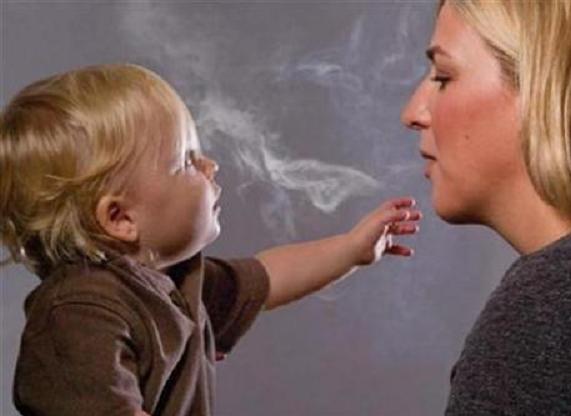
Smoking in front of children can make them addicted to nicotine

Thursday, June 16th, 2011
 
Most smokers are very aware of the damage they are doing to their own health – and know that others can also suffer though passive smoking. But a worrying new study reveals that smoking infront of children not only passes on the harmful effects of the smoke in the air – it can also get them hooked on cigarettes. A Concordia and University of Montreal study published in the Oxford journal Nicotine & Tobacco Research, found that tweens who repeatedly observe a parent, sibling, friend or neighbur consuming cigarettes are more likely to start smoking themselves.

‘Kids who see others smoking are more likely to take up the habit because they don’t perceive cigarettes as unhealthy,’ says lead study author Simon Racicot, of Concordia University’s Department of Psychology.

‘We found that kids who’d never smoked who were exposed to tobacco use were more likely to hold positive beliefs about the killer habit. These are the kids who are more likely to start smoking as teenagers.’

This new investigation builds on previous studies examining the negative effects of being surrounded by smokers.

Senior author Jennifer J. McGrath, a professor in the Concordia University Department of Psychology said around 60 per cent of children are exposed to secondhand smoke across North America.
‘Greater exposure to smokers is largely associated with greater exposure to nicotine,’ she said.
‘Children exposed to the same amounts of secondhand smoke as adults absorb higher doses of nicotine.
‘Early findings suggest that secondhand smoke exposure could possibly trigger addiction in the brain – before kids actually start smoking themselves.’

For the study, 327 11-13 year olds enrolled in French-language public schools were questioned about their smoking habits, the number of smokers in their entourage and the situations where they observed smoking.

‘Preteens who were surrounded by more smokers believed that there are greater advantages to smoking,’ says Racicot.

‘Therefore, smoking by parents, siblings, and friends increases risk factors for later smoking.’
The researchers argue that new prevention efforts must be tailored to children who are highly exposed to secondhand smoke – ensuring they are aware of the risks.

The general public also needs to be informed about how smoking around youth normalizes the dangerous habit.

‘When it comes to smoking around kids, the best thing a parent can do is to avoid exposing their kids to cigarettes and to secondhand smoke,’ says Racicot.

‘A parent should step outside of their home or car to smoke. And the addictive habit should remain out of sight, out of breath and out of mind.’

Miley Cyrus smoking cigarettes? Who cares?


Do you really care that Miley Cyrus is a smoker? Does anyone really care that she smokes cigarettes? What is the big deal? I simply don’t get it. People seem to be up in arms about the fact the Miley Cyrus smokes cigarettes. They claim that because she is a role model that she has some sort of responsibility to the children to be a good example to them. Give me a break. 

Miley Cyrus is not a role model. She has never been a role model. Cyrus has been an anti role model since she was 15 years old. We are talking about a girl who posed basically nude for a magazine when she was 15, has been caught smoking a bong, taken partially nude pictures of herself and allowed them somehow to get online, and humped a pole in front of young kids at the Teen Choice awards. This is the person everyone says is a role model?

Any parent who allows Miley Cyrus to be a role model for their children should have their children taken away from them because they obviously are not fit to be a parent.

Parents should sit down with their young children and let them know that what Cyrus does is not appropriate and should never be emulated under any circumstances. 

Parents should be their children’s role models not people like Miley Cyrus. People should leave Cyrus alone and let her live her life in peace and spend more time with their own children so people like Cyrus don’t have the influence over them that we all fear they do.

More Picture : here
More News : Cigarettes Flavour

Monday, 8 August 2011

Secondhand Smoke May Increase Risk for Nicotine Addiction

Wednesday, May 11th, 2011
 

Moderate secondhand smoke exposure results in occupancy of brain α4 β2 nicotinic acetylcholine receptors (nAChRs), which may increase vulnerability to smoking and nicotine addiction, new research shows. Study investigators found that after 1 hour of exposure to secondhand smoke in an enclosed space, a substantial amount of nicotine reaches the brains of nonsmokers and binds to receptors that are normally targeted by direct exposure to tobacco smoke — a finding that has important implications.

“We know that secondhand smoke exposure results in exposed individuals being more likely to become smokers and to have a harder time quitting smoking [if they are already smokers],” first author Arthur L. Brody, MD, from the Greater Los Angeles Veterans Affairs Healthcare System and the University of California, Los Angeles, told Medscape Medical News.
“Our study presents further evidence for the need to limit exposure to secondhand smoke in vulnerable individuals,” he added.

The study was published online May 2 in the Archives of General Psychiatry.

Priming the Brain
In laboratory rats, long-term exposure to cigarette smoke leads to nicotine dependence and an upregulation of nAChR levels in the brain. Yet, “brain nAChR occupancy from secondhand smoke exposure has not yet (to our knowledge) been demonstrated,” the researchers write.

In the study, 11 moderately dependent cigarette smokers and 12 nonsmokers underwent positron emission tomography with the radioligand 2-(18)F-FA-85380, which permits visualization of brain α4 β2 nAChRs, one of the most abundant nAChR subtypes in the brain.
Each participant underwent 2 scanning sessions during which they sat in the passenger seat of a car for 1 hour and were exposed to moderate secondhand smoke or to no secondhand smoke.

During the smoke exposure condition, the mean air carbon monoxide level was 7.4 parts per million (ppm) — significantly higher (P < .001) than during the control condition (0.5 ppm).
For the entire group (smokers and nonsmokers), moderate secondhand smoke exposure led to an average 19% brain α4 β2 nAChR occupancy, the researchers say.

Evidence Supports Public Smoking Ban

“These results show that even limited secondhand smoke exposure delivers enough nicotine to the brain to alter its function,” Nora D. Volkow, MD, director of the National Institute on Drug Abuse, who was not involved in the study, noted in a statement.

“Chronic or severe exposure could result in even higher brain nicotine levels, which may explain why secondhand smoke exposure increases vulnerability to nicotine addiction,” Dr. Volkow added.

The researchers also found that smokers had a 23% increase, on average, in craving with secondhand smoke exposure, and they saw a correlation between nAChR occupancy and craving alleviation with subsequent cigarette smoking. This finding suggests that moderate secondhand smoke exposure delivers a priming dose of nicotine to the brain that contributes to continued cigarette use in smokers, they say.

“This study,” Dr. Brody said, “gives concrete evidence to support policies that ban smoking in public places, particularly enclosed spaces and around children.”

Sources : Daily Mail

Monday, 1 August 2011

CIGARETTES CONTENTS


Eventhough Cigarettes can harm and even kill you, it is still can be sell legally at the market.
Currently there are ongoing lawsuits in the USA which aim to hold tobacco companies responsible for the effects of smoking on the health of long term smokers.
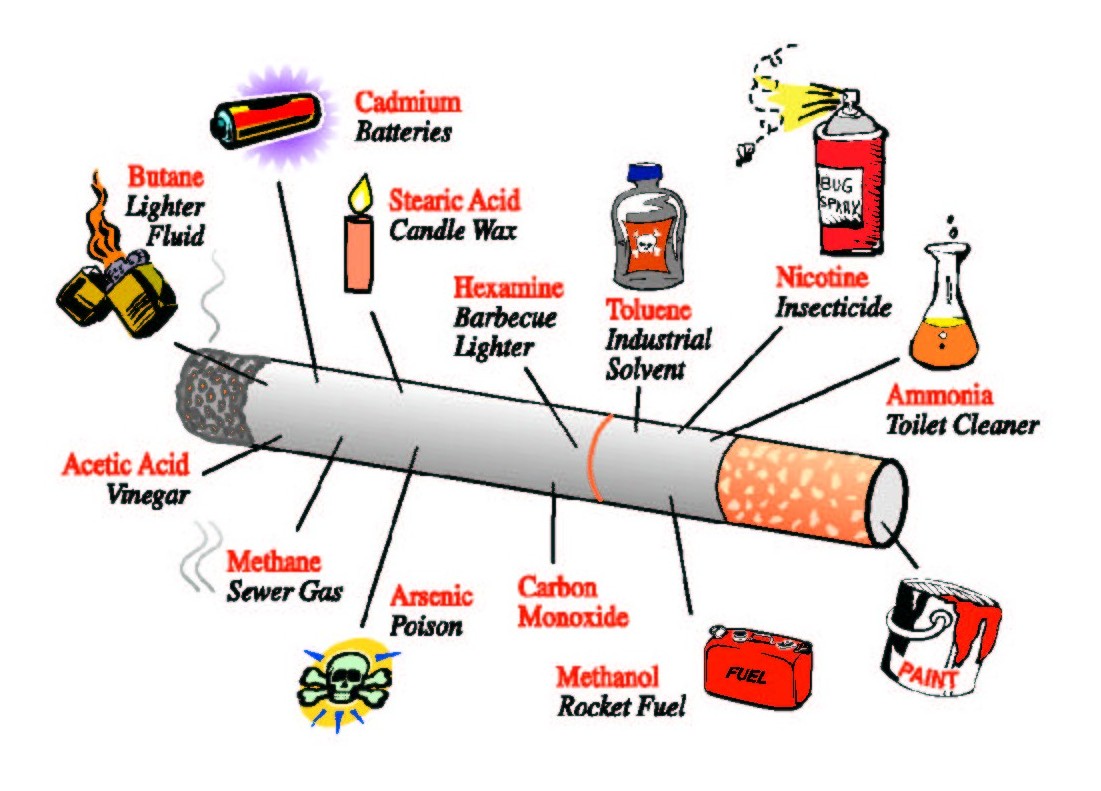
There are more than 4,000 ingredients in a cigarette other than tobacco. Common additives include yeast, wine, caffeine, beeswax and chocolate. Here are some other ingredients:


Ammonia: Household cleaner
Angelica root extract: Known to cause cancer in animals
Arsenic: Used in rat poisons
Benzene: Used in making dyes, synthetic rubber
Butane: Gas; used in lighter fluid
Carbon monoxide: Poisonous gas
Cadmium: Used in batteries
Cyanide: Deadly poison
DDT: A banned insecticide
Ethyl Furoate: Causes liver damage in animals
Lead: Poisonous in high doses
Formaldehiyde: Used to preserve dead specimens
Methoprene: Insecticide
Megastigmatrienone: Chemical naturally found in grapefruit juice
Maltitol: Sweetener for diabetics
Napthalene: Ingredient in mothballs
Methyl isocyanate: Its accidental release killed 2000 people in Bhopal, India in 1984
Polonium: Cancer-causing radioactive element


All things added together: death is in a cigarette


Source: www.quitsmokingsupport.com/